 England Legends
 Pakistan Legends
Oct 14 · 4:30 PM
England Legends
Pakistan Legends
 Gladiators
 Queens
 Takashinga 1
 Rimuka
 Panama Women
 New Zealand Women
 Green Shield FC
 SOSA
SOSA
 Millonarios
 Deportiva Once Caldas
 Irtysh Pavlodar
 FC Astana
 Vissel Kobe
 Jeonbuk Hyundai Motors
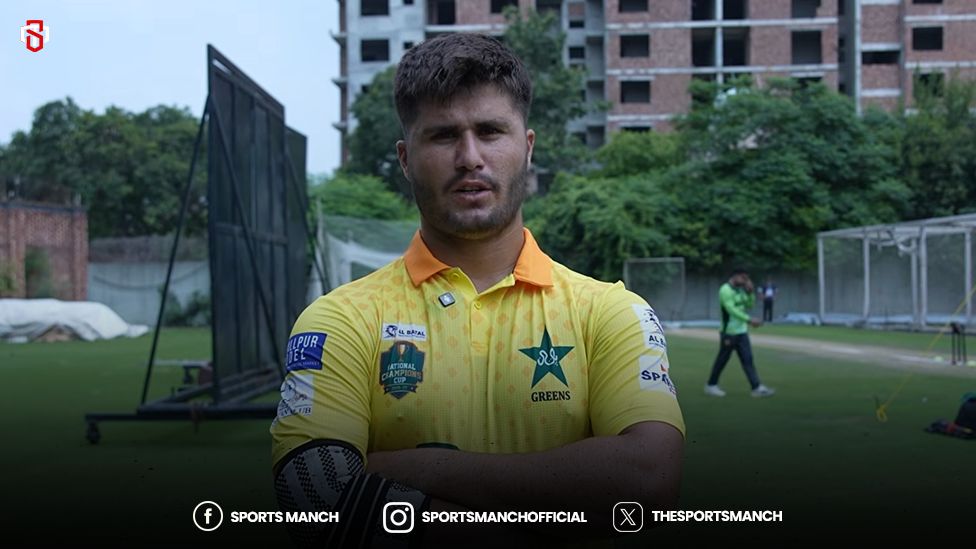
There were days when Pakistan ruled the cricketing world with their express fast bowlers. There were days when the country’s reserve stock of pacers was so deep that finding a place for a good bowler in the national side was a challenge in itself. Those days, however, seem to be fading.
In recent years, Pakistan’s fast bowlers have lost some of their venom amid a host of issues within the system.
Two decades ago, news of a Pakistani fast bowler clocking 150kph would hardly have raised eyebrows. Today, however, when the country’s once-renowned fast-bowling factory appears to be in decline, a young bowler breaching the 150kph mark is enough to grab attention. That is precisely why Qayyum Khan’s name has been making headlines over the past few days.
But who is Qayyum Khan? Where does he come from? And what has his journey looked like so far?
Let’s take a dive into the young pacer’s cricketing journey and discover the story behind Pakistan’s latest express-bowling prospect.
Qayyum Khan represents the Faisalabad region. He recently joined the Pakistan Cricket Board’s (PCB) development camp for bowlers at the National Cricket Academy (NCA) in Lahore on August 24, 2026.
During the five-day camp (24-28 August), the fast bowlers took part in fitness tests and target-bowling drills under the supervision of Pakistan men’s white-ball assistant coach Ashley Noffke.
Among the cohort of 20 bowlers being developed by PCB, Qayyum is the only player yet to make his competitive cricket debut beyond that one Grade-II Silver match.
Pakistan’s men’s team selector and Director of the High-Performance Centre, Aaqib Javed, disclosed the pace sensation in a PCB Podcast.
“We have Ali Raza, then Subhan, and right now we have Abuzar, who is bowling at 146 [kph]. Razaullah is there, and he is currently clocking 145 plus. And then, we’ve found a rare diamond from somewhere in Jhang… Qayyum,” Aaqib said.
“He is clocking 150 and above. So now, we are just waiting to train them thoroughly during the summer so that we can bring them forward next season.”
When Qayyum Khan first bowled at 150+ kmph, he wasn’t bowling in front of PCB scouts. He was found in Jhang, a small city in Punjab, Pakistan, that has rarely produced elite Pakistani cricketers.
Some of the known cricketers are umpire Aleem Dar and pacer Ehsan Adil, who now plays for USA.
When Qayyum Khan was called to the PCB’s development camp in August, he had made only one appearance in the President’s Trophy Grade-II Silver tournament for Sports Board Punjab, the lowest form of Pakistan’s domestic cricket ladder.
Grade-II Silver is where young, unproven bowlers often begin their careers; many of these bowlers have produced raw pace on these dusty grounds.
Aaqib Javed described him as a “rare diamond from “, but the reality is that such diamonds found in small cities stay hidden for far too long.
Unlike bowlers from established cricket hubs like Lahore or Karachi, where coaches, scouts, and media attention are readily available, Qayyum had to make his mark on his own.
Pakistan has always been a land of raw cricketing talent. From small towns and lesser-known cities, the country has produced fast bowlers with extraordinary natural ability. Qayyum is an example of this untapped talent, while the other story of Yasir Jan shows that Pakistan’s soil has produced players with abilities rarely seen in cricket.
Yasir, a fast bowler from Charsadda, grabbed attention in 2016 after Lahore Qalandars discovered his remarkable ability to bowl with both arms. The 21-year-old could reportedly reach around 145 km/h with his right arm and 135 km/h with his left, making him one of the most unusual fast-bowling prospects Pakistan had seen.
Despite having no competitive cricket experience, his raw pace and ambidextrous ability immediately caught the attention of former Pakistan fast bowler Aaqib Javed, who signed him to a long-term developmental contract. But after that, the bowler vanished like he never existed, so finding bowlers is not the solution; developing them to represent Pakistan at the highest level is also important, which the PCB lacks.
READ: Mohammad Abbas enters elite club with 900 first-class wickets
Yasir’s story is a reminder of how much potential exists beyond Pakistan’s major cricketing centres. His ability was not developed inside an elite academy or a sophisticated cricketing system; it was discovered while he was working at his family’s vegetable shop and playing cricket in his spare time.
And Yasir is not the only case. The soil of Pakistan continues to produce raw diamonds like Qayyum and Yasir, particularly from smaller cities and towns where countless young players dream of becoming fast bowlers.
Pakistan’s cricketing soil is filled with hidden talent. What these players need is not just discovery, but a system capable of nurturing and protecting them. If Pakistan can provide the right training, fitness, facilities and long-term support, these raw diamonds can be transformed into future stars capable of representing the country at the highest level.
Pakistan’s domestic cricket system, once a breeding ground for world-class fast bowlers, is now unfortunately struggling with a fundamental problem: how to keep young bowlers fit and healthy and provide them with the best training.
Young fast bowlers in Pakistan often miss out on professional guidance and fitness programs crucial for pace bowling longevity. The country’s domestic cricket infrastructure has not kept pace with modern requirements and technology; the physical demands of fast bowling can be punishing.
According to former Pakistan fast bowler Mohammad Zahid, during a six-to-seven-month observation period of Grade 2 and first-class matches, he “did not see a single fit fast bowler in Pakistan’s domestic cricket” who met historical fitness benchmarks.
Love sports updates on the go? Click here to follow us on WhatsApp Channel
Think about what that means: Qayyum Khan is training in a system where the standard of fitness conditioning has dropped so far that most bowlers around him don’t even meet basic international standards yet.
Most Pakistani bowlers, including those at Qayyum’s level, receive no such tailored care. They bowl, they hope they don’t get injured, and if they do, they hope they recover. It is survival, not development.
There is a viral YouTube video where Qayyum Khan reportedly bowled to Asif Ali, the veteran Pakistan batter who got bowled out even before he could start his straight drive.
Observers noted that he is “seriously quick”. This wasn’t a high-profile match or a packed stadium. It was a moment captured on camera, likely during a practice session or low-level tournament. But in that one ball, one batter, one decisive moment, Qayyum proved he had the potential to represent Pakistan at an international level and make his country proud.
For a young bowler from Jhang, this video became his passport. It wasn’t the traditional path through prestigious tournaments or media coverage. It was raw, unfiltered evidence of what he could do.
But one video is not enough to change a career. Recognition from the right people, like Aaqib Javed, described Qayyum Khan as a “rare diamond from somewhere in Jhang” who was “clocking 150 and above ” kilometres per hour. This wasn’t casual praise.
Aaqib is a man who knows pace bowling intimately — he has bowled it, coached it, and now shapes Pakistan’s bowling future. When someone of his stature calls you a “rare diamond,” it resonates.
What made Qayyum Khan’s journey remarkable was his lack of experience. Among the 20 bowlers in the development programme who participated, he was the only one who had yet to make his competitive debut, aside from one Grade-II Silver appearance. He had no proven record, only raw, undeniable pace.
Instead of chasing fame after his viral video, Qayyum accepted the NCA development camp, where he could focus on training and improving away from the spotlight.
Qayyum had it at an elite level. But pace alone is not enough; discipline, training and mental strength determine whether talent becomes a career.
What Comes Next: The Road to International Cricket
The PCB’s Plan
The summer will focus on intensive training before the bowlers move into top-level domestic cricket. The goal is to turn raw pace into consistent performance.
The PCB’s new development contracts, offering young players salaries of up to PKR 1 million per month, could help emerging bowlers focus on long-term development instead of chasing immediate league contracts.
For Qayyum, this support provides the opportunity to develop without financial pressure.
After the NCA camp, Qayyum must prove himself in domestic cricket by maintaining his pace, developing variations, handling different conditions and staying injury-free.
The next 12–18 months will be crucial in determining whether his raw potential can become consistent performance.
Pakistan needs genuine express pace across Test, ODI and T20 cricket. New high-performance centres in Faisalabad and Sialkot are also part of the PCB’s broader plan to strengthen the fast-bowling pipeline.
For Qayyum, international cricket is now a realistic possibility—but only if he continues to develop and perform.
Pakistan’s fast-bowling stocks have struggled in recent years, making the emergence of Qayyum and other young speedsters particularly important.
They represent a chance to revive the tradition once defined by Wasim Akram, Waqar Younis and Shoaib Akhtar.
But pace alone is not enough. Injury management, discipline, mental resilience and proper guidance will determine whether Qayyum reaches the highest level.
Qayyum’s viral video introduced the world to his speed. Now comes the real test: turning a 150+ km/h pace into international-class bowling.
The opportunity is there. The talent is there. Now, he must turn potential into performance—and performance into a legacy.
Aleena is a sports writer at Sports Manch, with a keen interest in cricket and sports journalism. Her work focuses on creative storytelling, feature writing, and SEO content, with an emphasis on producing clear, engaging, and well-researched stories. She is passionate about exploring compelling sports narratives and continues to develop her skills as a versatile and impactful writer.